316L Stainless Steel Wire Mesh Micron Filter Screen | MESCO
- Model
- 316L Stainless Steel Wire Mesh
Review
Description
What Is 316L Stainless Steel Wire Mesh?
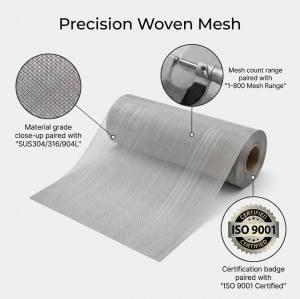
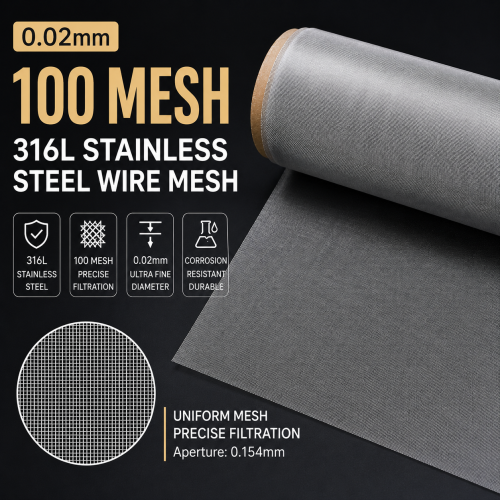
316L stainless steel wire mesh — also called 316L wire cloth, SS woven mesh, stainless filter screen, or stainless wire fabric — is a precision-woven textile made from ultra-fine 316L stainless steel wire. In this specification, each wire is drawn to 0.02 mm (20 microns) in diameter and woven at 100 wires per linear inch in both the warp and weft directions, producing a uniform square aperture of approximately 234 microns (0.234 mm) and an open area ratio of approximately 85.1%.
The wire material is AISI 316L (UNS S31603), an austenitic stainless steel alloyed with 2–3% molybdenum and held to a maximum carbon content of 0.03% — the 'L' designation. These two compositional controls deliver the two properties that define 316L as the premium choice for filtration, chemical processing, and food-grade mesh: outstanding resistance to chloride-induced pitting and crevice corrosion (from the molybdenum), and immunity to sensitization and intergranular corrosion during welding or heat exposure (from the low carbon).
The result is a mesh that combines the dimensional precision of a 100-mesh screen — verified to ASTM E11 and ISO 9044 sieve-calibration standards — with the material integrity required in pharmaceutical clean rooms, offshore marine environments, and aggressive chemical process streams where lesser alloys fail.

Understanding Mesh Count, Wire Diameter, and Aperture
Mesh Count
'100 mesh' means there are 100 wires (strands) crossing per linear inch in both the horizontal (weft) and vertical (warp) directions. A higher mesh count means more wires per inch, smaller openings, and finer filtration. 100 mesh is a widely used specification in filtration, screen printing, and pharmaceutical processing — fine enough to capture most visible particles, yet open enough to allow reasonable flow rates.
Wire Diameter: 0.02 mm (20 Microns)
At 0.02 mm, the wire in this mesh is finer than a human hair (approximately 60–80 µm). Drawing stainless steel wire to 20 microns requires a multi-pass cold-drawing process through precision diamond dies, with intermediate annealing to restore ductility. Tight diameter control — ± 0.001 mm — is essential: a slight oversize reduces the aperture, a slight undersize widens it, both compromising the mesh's filtration consistency.
Aperture and Open Area
The aperture (opening width) is determined by the mesh pitch minus the wire diameter: (25.4 mm ÷ 100) − 0.02 mm = 0.234 mm. The open area — the percentage of the total mesh surface that is open space — is (0.234 / 0.254)² × 100 ≈ 85.1%. This high open area minimizes pressure drop across the mesh, which is critical in high-throughput filtration processes and screen-printing applications where viscous media must pass through uniformly.
316L vs 316 vs 304 Stainless Steel: Why Grade Matters for Wire Mesh
| Property | 316 Standard | 316L (This Product) |
| Max Carbon (C) | ≤ 0.08% | ≤ 0.03% |
| Weld Sensitization Risk | Present if not annealed post-weld | Eliminated — no carbide precipitation |
| Intergranular Corrosion | Possible in HAZ | Resistant without post-weld HT |
Pitting Resistance (PREN) | ≈ 24–26 | ≈ 24–26 (equivalent) |
Cleanability / Sterilization | Good | Excellent — preferred for pharma / food |
Best For | General industrial / structural | Chemical, pharma, food, marine, filtration |
For wire mesh applications involving welded frames, frequent sterilization cycles, exposure to chlorides (seawater, brine, cleaning agents), or food/pharmaceutical product contact, 316L is not a premium option — it is the correct engineering specification. Substituting 304 or even standard 316 introduces failure modes that 316L eliminates by design.

Why Source 316L Wire Mesh from MESCO?
20 µm Wire Precision
Wire diameter controlled to ± 0.001 mm. Consistent diameter across the full roll length ensures aperture uniformity critical for filtration accuracy.
Superior Corrosion Resistance
Mo 2–3% addition gives 316L outstanding resistance to chloride pitting, crevice corrosion, and reducing acids — far beyond 304 stainless steel.
Weld-Safe & Sterile
Extra-low carbon (C ≤ 0.03%) eliminates sensitization and intergranular corrosion at weld heat-affected zones. Cleanable to pharmaceutical and food-grade standards.
Tight Mesh Tolerance
100 mesh count verified to ASTM E11 / ISO 9044 sieve standards. Open area ratio ≈ 85.1% maintained batch-to-batch for reliable flow rates.
Full Material Certification
Mill test report (MTR), chemical analysis (ICP), mechanical properties, and RoHS compliance certificate supplied with every order.
Custom Roll & Cut Sizes
Standard rolls 500 / 1,000 / 1,220 mm wide. Custom widths, sheet cut-to-size, disc punching, and laser cutting available on request.
Key Product Features
- Material: AISI 316L (UNS S31603) — Mo 2–3%, C ≤ 0.03%, PREN ≈ 24–26
- 100 mesh count — 100 wires per inch in both warp and weft directions
- Wire diameter 0.02 mm (20 µm) — precision drawn ± 0.001 mm tolerance
- Aperture ≈ 0.234 mm (234 µm) — open area ≈ 85.1%
- Plain weave standard; twill weave available on request
- Bright annealed surface; electropolished finish available for Ra < 0.8 µm
- Salt spray resistance ≥ 1,000 h (ASTM B117); no rust in standard service conditions
- Temperature rated: continuous to 870 °C, intermittent to 925 °C
- Compliant: ASTM A580, ASTM E11, ISO 9044, GB/T 5330; EU food-contact Regulation 1935/2004
- Custom roll widths, lengths, disc blanks, and framed filter elements available
- Full documentation: MTR, chemical cert, aperture inspection report, RoHS declaration
Technical Specifications
| Parameter | Specification |
| Product Name | 316L Stainless Steel Wire Mesh — 100 Mesh, 0.02 mm Wire Diameter |
| Mesh Count | 100 mesh per inch (100 openings per linear inch) |
| Wire Diameter | 0.02 mm (20 micron) |
Mesh Opening (Aperture) | ≈ 0.234 mm (234 microns) — calculated: (25.4 / 100) − 0.02 |
Open Area Ratio | ≈ 85.1% |
Weave Type | Plain weave (standard); Twill weave available on request |
Material Grade | AISI 316L (UNS S31603) — extra-low carbon stainless steel |
Chemical Composition | C ≤ 0.03% | Cr 16–18% | Ni 10–14% | Mo 2–3% | Mn ≤ 2% | Si ≤ 0.75% | P ≤ 0.045% | S ≤ 0.03% |
Wire Tensile Strength | ≥ 620 MPa (drawn wire) |
Surface Finish | Bright annealed; electro-polished finish available on request |
Roll Width | 500 mm / 1,000 mm / 1,220 mm (custom widths available) |
Roll Length | 30 m / 50 m standard; custom lengths |
Sheet / Cut Size | Custom cut-to-size available; MOQ applies |
Corrosion Resistance | Salt spray ≥ 1,000 h (ASTM B117); pitting resistance PREN ≈ 24–26 |
Temperature Range | Continuous service up to 870 °C; intermittent up to 925 °C |
Standards Reference | ASTM A580, ASTM E11, ISO 9044, GB/T 5330 |
Packing | Rolled on cardboard core, plastic film wrap, carton or wooden crate |
Industry Applications — 316L Stainless Steel Wire Mesh, 100 Mesh
| Industry | Typical Use | Why 316L / 100 Mesh |
| Pharmaceutical | Tablet press screens, API filtration, sterile process filtration | C ≤ 0.03% prevents carbon leach; Mo resists CIP/SIP chemical cycles |
| Food & Beverage | Strainers, centrifuge screens, sugar / starch filtration, brewing | FDA-compliant alloy; corrosion-free in acidic food streams; cleanable |
| Chemical Processing | Acid filtration, catalyst retention, solvent straining | Mo addition resists HCl, H₂SO₄, acetic acid — critical where 304 fails |
Water Treatment | Ultrafiltration pre-screens, seawater intake filters, RO pre-filters | Chloride-resistant; ≈ 234 µm aperture removes particulates ≥ 0.23 mm |
Electronics / PCB | Precision solder paste stencils, SMT printing screens | 20 µm wire ensures consistent paste volume deposit; dimensionally stable |
Aerospace | Hydraulic fluid filtration, fuel system screens, vent mesh | Temperature rated to 870 °C continuous; vibration-resistant weave |
Laboratory | Analytical sieves, gravimetric filtration, sample preparation | ASTM E11 / ISO 9044 calibrated aperture; traceable MTR for audit records |
Petroleum & Gas | Crude oil screen, gas scrubber, down-hole sand control | PREN 24–26 handles sour gas (H₂S) and chloride-laden crude streams |
Frequently Asked Questions — 316L Wire Mesh, 100 Mesh, 0.02 mm
What does '100 mesh 0.02 mm wire' mean, and how large is each opening?
100 mesh means there are 100 wires per linear inch in each direction. With a wire diameter of 0.02 mm (20 microns), the opening (aperture) between wires is calculated as: (25.4 mm ÷ 100) − 0.02 mm = 0.234 mm (234 microns). This aperture determines the particle size that the mesh will retain or pass — particles larger than 234 µm are retained; smaller particles pass through.
Why is 316L specified instead of 304 or standard 316 stainless steel for wire mesh?
316L adds two key advantages over 304: first, molybdenum (2–3%) dramatically improves resistance to chloride pitting and crevice corrosion, making it suitable for marine, chemical, and food-processing environments where 304 is marginal or fails. Second, the 'L' (extra-low carbon, ≤ 0.03%) eliminates sensitization — the precipitation of chromium carbides at grain boundaries during welding or high-temperature exposure — which is the failure mechanism behind intergranular corrosion in standard 316. For welded filter housings and multi-cycle sterilization, 316L is the industry-standard specification.
What is the filtration rating of 100 mesh 316L stainless steel wire cloth?
100 mesh plain-weave screen with 0.02 mm wire has a nominal aperture of approximately 234 microns (0.234 mm). It will reliably retain particles ≥ 234 µm under normal flow conditions. For absolute filtration ratings (which account for particle shape and flow dynamics), conservative practice is to use 150–200% of the aperture as the retained particle size — i.e., this mesh is typically rated for particles in the 150–234 µm nominal filtration range. For finer ratings, multi-layer sintered mesh or membrane media are recommended.
How do I calculate the open area of 100 mesh / 0.02 mm wire?
Open area (%) = [(aperture) / (aperture + wire diameter)]² × 100. For this product: aperture = 25.4/100 − 0.02 = 0.234 mm. Open area = (0.234 / 0.254)² × 100 ≈ 85.1%. High open area means low flow restriction, which is important in filtration and screen-printing applications where pressure drop across the mesh must be minimized.
Can 316L stainless steel wire mesh be welded or framed?
Yes. 316L's extra-low carbon content makes it weld-friendly — no post-weld annealing is required to restore corrosion resistance, unlike standard 316. The mesh can be spot-welded, TIG-welded, or resistance-welded to 316L frames or housings. For applications requiring sanitary framing (pharmaceutical, food), electropolishing of the weld area is recommended to restore the passive oxide layer.
What is the maximum operating temperature of 316L stainless steel wire mesh?
316L wire mesh can be used continuously to 870 °C (1,600 °F) and intermittently to 925 °C (1,700 °F) in air. Note: 316L has slightly lower creep strength than 310 or 321 stainless steel at sustained temperatures above 700 °C. For high-temperature filtration above 700 °C, we recommend discussing your application with our technical team for appropriate grade selection.
Is 316L stainless steel wire mesh suitable for food and pharmaceutical contact?
Yes. AISI 316L is widely accepted for food-contact and pharmaceutical applications. It complies with EU Regulation 1935/2004 (food contact materials), FDA 21 CFR requirements for food-contact metals, and is the alloy of choice specified in USP and EU GMP guidance for product-contact filtration surfaces. Electropolished finish is available for surfaces requiring Ra < 0.8 µm per GMP guidance.
What quality documentation is available?
Standard documentation with every order: mill test report (MTR) with chemical analysis (ICP-OES) and mechanical properties; mesh count and aperture inspection certificate per ASTM E11 or ISO 9044; RoHS compliance declaration. On request: salt-spray test report (ASTM B117), electopolish certificate, SGS or third-party inspection, and EN 10204 3.1 or 3.2 certificates.
Contact Us
✉ mesco@mescogroup.com.cn
🌐 www.mescogroup.com.cn
📞 +86-15134565556